📱 Screen Time Interventions: What Works, What Doesn’t, and What’s Missing
Over the past decade, awareness around youth screen use has grown rapidly. In response, schools, parents, and policymakers have introduced a wide range of interventions—from screen time limits to digital detox programs.
But a critical question remains:
Do current interventions actually work—and if not, what’s missing?
Research suggests that while many interventions are well-intentioned, their effectiveness is often limited, inconsistent, and highly context-dependent.
This article breaks down the major types of existing interventions, evaluates what evidence supports, and highlights key gaps that future solutions must address.
1. The Most Common Approach: Time Limits
🔹 “Just Reduce Screen Time”
The most widespread intervention is simple:
Set daily limits (e.g., 1–2 hours)
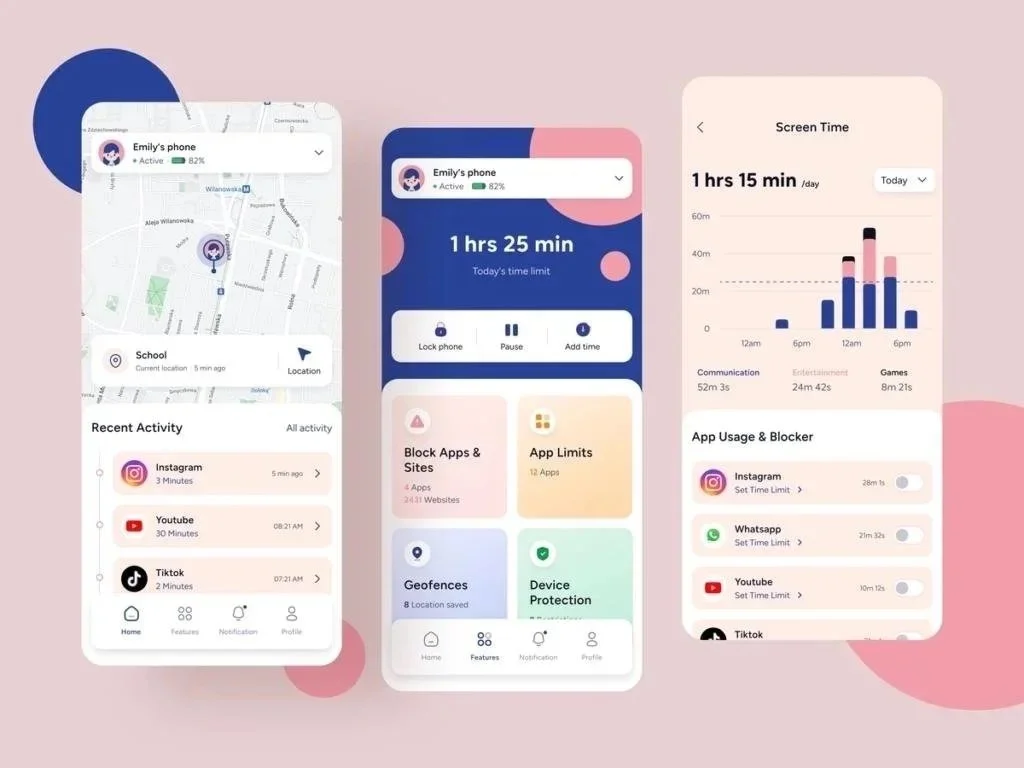
Use parental control apps
Restrict device access at certain times
Organizations like the American Academy of Pediatrics have historically recommended screen time limits, especially for younger children.
🔹 What the Research Says
However, evidence shows that time alone is a weak predictor of outcomes.
A large-scale analysis found that total screen time has only small associations with adolescent well-being (Orben & Przybylski, 2019).
Why?
Because it ignores:
Content (scrolling vs learning vs creating)
Context (alone vs social vs family use)
Timing (daytime vs late-night use)
Motivation (boredom, stress, connection)
➡️ Conclusion: Time limits are easy to implement—but insufficient on their own.
2. Digital Detox & Abstinence Models
🔹 The Idea
Some programs promote:
Temporary “digital detox” periods
No-phone school policies
Weekend or vacation disconnection
🔹 Evidence & Limitations
Short-term studies show that reducing or pausing social media use can:
Improve mood
Reduce anxiety and loneliness
(Hunt et al., 2018)
However, these effects often:
Fade once normal usage resumes
Do not address underlying habits or triggers
➡️ Conclusion: Detox works as a reset—but not as a sustainable solution.
3. Parental Control & Monitoring Tools
🔹 Examples
Screen time tracking apps
App blocking tools
Content filters
Location and activity monitoring
🔹 What Research Shows
Monitoring can:
Reduce exposure to harmful content
Provide structure for younger children
But for adolescents, excessive control often leads to:
Workarounds (secondary accounts, hidden usage)
Reduced trust
Lower willingness to seek parental help
(Kerr et al., 2010; digital extensions)
➡️ Conclusion: Monitoring without trust can backfire—especially for teens.
4. School-Based Education & Awareness Programs
🔹 Typical Interventions
Digital citizenship classes
Screen time awareness seminars
Anti-cyberbullying campaigns
🔹 Effectiveness
These programs can improve:
Knowledge
Awareness
Short-term attitudes
But research shows limited long-term behavioral change unless paired with:
Ongoing reinforcement
Skill-building (not just information)
Real-life application
(Durlak et al., 2011 — broader SEL program evidence)
➡️ Conclusion: Awareness alone does not change behavior.
5. Behavior-Based Interventions (More Promising)
🔹 Habit-Focused Approaches
Emerging research supports interventions that focus on:
Self-regulation
Habit formation
Environmental design
Examples:
Turning off notifications
Removing apps from home screens
Creating friction (password barriers, grayscale mode)
These approaches align with behavioral science principles:
Reduce cues
Increase effort
Shift default behaviors
➡️ Conclusion: Changing the environment is often more effective than relying on willpower.
6. Why Most Interventions Fall Short
Across studies, several consistent limitations emerge:
❌ 1. Lack of Personalization
Most interventions treat all screen use the same.
But in reality:
A student using YouTube for learning ≠ endless scrolling
A socially isolated teen ≠ a well-supported teen
❌ 2. No Real-Time Support
Interventions are often:
Scheduled (workshops, rules)
Reactive (after problems occur)
But problematic screen use happens in the moment:
Late-night scrolling
Emotional coping
Habit loops
❌ 3. Over-Reliance on External Control
Many solutions depend on:
Parents enforcing rules
Schools setting restrictions
This fails to build:
Internal self-regulation
Personal agency
❌ 4. Ignoring Underlying Drivers
Screen overuse is often a symptom of:
Stress
Loneliness
Academic pressure
Lack of alternative activities
Without addressing these, behavior tends to return.
7. What the Research Suggests We Need Next
The next generation of interventions should focus on:
✔ Individualized Support
Adapt to:
User patterns
Emotional states
Usage intent
✔ Real-Time Intervention
Support users:
At the moment of temptation
During emotional triggers
Before habits escalate
✔ Agency-Based Design
Instead of:
“Restrict behavior”
Shift to:
“Empower self-regulation”
✔ Integrated Systems
Combine:
Parents
Schools
Students
Into a coordinated ecosystem—not isolated efforts.
8. A Shift in Framing
One of the most important insights from research is this:
The goal is not to eliminate screen use—but to develop healthier digital habits.
This reframing changes everything:
From restriction → to skill-building
From control → to collaboration
From fear → to understanding
Conclusion
Current screen time interventions are:
Helpful but limited
Often short-term
Rarely personalized
Too focused on control
The strongest evidence suggests that sustainable change comes from building internal habits, not enforcing external rules.
The future of intervention is not:
“How do we get teens off their phones?”
But rather:
“How do we help them use technology in ways that support their well-being, goals, and identity?”
That is where meaningful, scalable impact lies.
References
American Academy of Pediatrics. (2016). Media and young minds. Pediatrics, 138(5), e20162591.
Durlak, J. A., Weissberg, R. P., Dymnicki, A. B., et al. (2011). The impact of enhancing students’ social and emotional learning. Child Development, 82(1), 405–432.
Hunt, M. G., Marx, R., Lipson, C., & Young, J. (2018). No more FOMO: Limiting social media decreases loneliness and depression. Journal of Social and Clinical Psychology, 37(10), 751–768.
Kerr, M., Stattin, H., & Burk, W. J. (2010). A reinterpretation of parental monitoring. Developmental Psychology, 46(4), 1002–1012.
Orben, A., & Przybylski, A. K. (2019). The association between adolescent well-being and digital technology use. Nature Human Behaviour, 3(2), 173–182.
